How we scaled Vesto to 50 inbound demos per month with Meta ads and three funnel architectures
4 min read
Vesto is a treasury and cash management platform built for CFOs and finance teams managing complex multi-entity operations.
They came to us with a working product and a small but growing customer base. What they didn't have was a repeatable inbound demo engine.
We built one across Meta, using three different funnel architectures running in parallel. Here's exactly how.
Headline results
50+ Inbound demos per month at scale
~$140 Blended cost per booked demo
3 Distinct funnel architectures tested in parallel
About Vesto
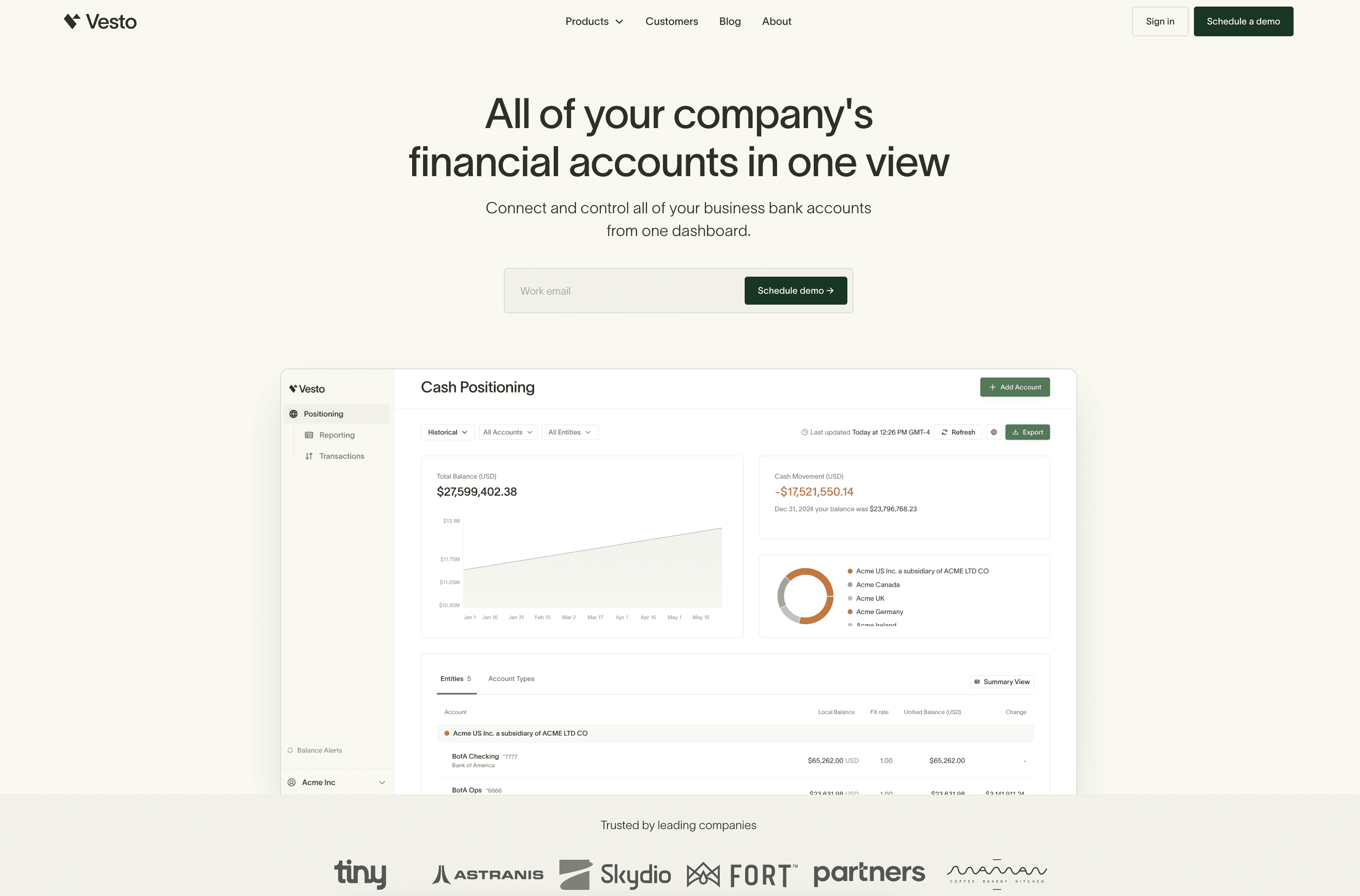
Vesto is a cash management and treasury platform for finance teams.
The product solves a specific pain: finance teams juggling multiple bank logins, spreadsheets, and entities to track cash across the business.
Vesto consolidates all of that into a single dashboard.
The ICP is CFOs and finance leaders at growing companies, typically those with multiple bank accounts, multi-entity structures, or treasury workflows complex enough that spreadsheets are breaking down.
It's a high-LTV product with a meaningful average contract value, which matters because it's what made the unit economics on a $140 cost per demo work.
When they came to Traction, the product was strong and the early customers loved it. The acquisition engine just hadn't been built yet.
Where Vesto was before working with Traction
Before
Inconsistent inbound demo flow.
No tested funnel architecture.
Limited paid acquisition spend, no system around it.
Demos coming primarily from founder network and warm intros.
After
50+ inbound demos booked per month from paid.
Three funnel types tested in parallel, with clear winners identified.
Repeatable cost per demo on the channels that worked.
Acquisition decoupled from founder network.
What we built
The interesting part of the Vesto engagement isn't the channel mix.
It's the funnel architecture.
We tested three distinct funnel types in parallel on Meta. Each one had a different theory about how to convert a cold CFO into a booked demo.
Here's what we ran, what worked, and what we'd tell any other B2B fintech to think about before they spend a dollar.
Funnel 1: The Core Qualification Funnel
The workhorse. Highest demo volume, most predictable cost.
The setup.
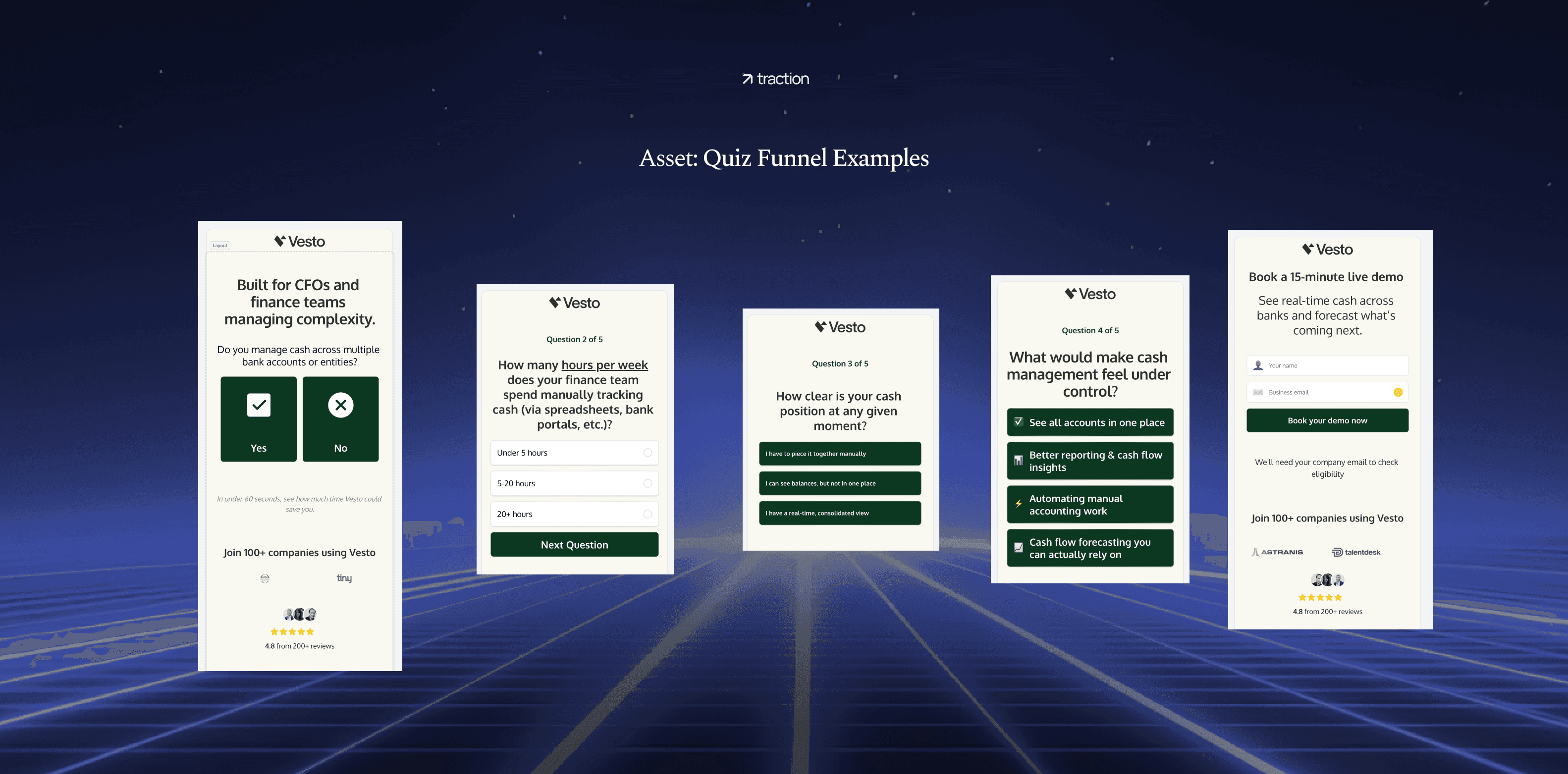
Cold ad on Meta, drives traffic to a Perspective-built quiz funnel.
Binary opener on the landing page asking a high-commitment question (something like "Do you juggle multiple bank logins or company entities?").
3 to 5 qualifying questions covering pain quantification, current tooling, team size, and budget.
Results page confirming fit. Then a Calendly booking embed.
Why it works.
The quiz does two jobs at once.
First, it psychologically commits the prospect to the problem before asking for the demo. By the time they hit the booking page, they've spent 60 seconds telling Vesto exactly how much pain they're in.
Second, it qualifies. Sales calls coming through this funnel arrive with context already built.
The CFO has self-identified their biggest pain, told us their stack, and confirmed budget fit before they ever speak to a human.
What the numbers said.
The Core Funnel delivered 80 booked demos at $152 per demo on its highest-volume campaign. A separate variant ran 77 demos at $129.
This was the campaign we kept scaling.
The judgement call.
We initially built the Core Funnel as a longer 6-question quiz.
We cut it to 4 after seeing drop-off concentrated on questions 5 and 6, which were nice-to-have qualification data but not critical.
Cost per demo dropped about 18% after the cut.
Lesson: every quiz question is friction. If the sales team can answer it in the first 30 seconds of the call, it doesn't belong in the quiz.
Funnel 2: The VSL Funnel
The thesis here was different.
CFOs are often skeptical of B2B fintech tools. The category is crowded, the buyer is risk-averse, and a quiz funnel can feel transactional for a six-figure-decision purchase.
So we tested a video sales letter funnel.
The setup.
Cold ad on Meta drives to a long-form landing page anchored by a 6-minute VSL.
The video walks through the problem (treasury chaos), agitates the cost of the current state (hours wasted, bank fees missed, decisions made on stale data), and presents Vesto as the consolidation layer.
Booking CTA reveals after the watch milestone.
Why we tested it.
VSLs typically outperform quiz funnels on three dimensions.
Higher quality of demos booked (the prospect has self-selected by watching 6 minutes of content).
Better narrative control (you get to tell the full story rather than relying on a quiz to do it for you).
Stronger trust-building for skeptical buyers.
What the numbers said.
The VSL funnel delivered higher cost per demo ($463 on the call-gen variant, $93 per lead on the lead-gen variant) but the demos that came through were noticeably better qualified.
Lower volume, higher intent.
The judgement call.
VSLs work, but they're slow to validate.
You need 1,000+ landing page visits before you can trust the conversion rate, and CFOs don't tend to watch 6 minutes of video at scale on Meta the way consumer audiences will.
We kept the VSL running as a secondary funnel for retargeting and warm audiences, where the watch-through rates were dramatically better.
If you're considering a VSL for B2B, run it on warm traffic first. Don't try to validate it on cold prospecting.
Funnel 3: The AI-Enabled Funnel
The newest layer. Cold ad to landing page, where an AI chatbot qualifies inbound traffic in real time.
The setup.
Same cold Meta ad creative as the Core Funnel.
But instead of a static quiz, the landing page opens with an AI chat interface that asks contextual qualifying questions.
The chat dynamically adapts based on the prospect's answers. Different questions for a Series A startup vs. a private equity portfolio company. Different framing for a US prospect vs. an international one.
If the chat detects strong fit, it routes directly to a Calendly booking.
If it detects partial fit, it routes to a lead magnet for nurture.
If it detects poor fit, it ends the conversation gracefully.
Why we tested it.
A static quiz funnel asks every prospect the same questions in the same order.
That's fine. But it leaves intelligence on the table.
A CFO at a 5,000-employee multinational and a finance lead at a 50-person Series A both juggle bank logins. They're not the same buyer. They shouldn't get the same funnel.
AI chat lets the funnel branch in real time. More relevant questions for the right prospect, faster routing to booking, automatic deflection of low-fit traffic.
What the numbers said.
Cost per demo came in competitive with the Core Funnel.
But the more interesting number was sales team feedback. Demos coming through the AI-enabled funnel arrived with significantly more context attached, and close rates trended higher.
It's still early to call this a definitive win, but the architecture is clearly the direction this category is moving.
The judgement call.
Don't build the AI funnel first.
Build the Core Funnel first, validate that the messaging and offer work, then layer the AI funnel on top using the same core questions as a starting point.
The AI funnel only works when you already know what good qualification looks like. It's not a shortcut to figuring that out.
Why three funnels and not one
The instinct in B2B is to pick one funnel and optimise it forever.
We've found the opposite to be true in the first 90 days of any new client engagement.
You don't know which funnel architecture will work best for your audience until you test multiple in parallel.
Vesto is the perfect example.
If we'd guessed and committed to the VSL funnel first, we'd have spent two months getting demos at $463 each before realising the Core Funnel was waiting at $130.
If we'd committed to the AI funnel first, we wouldn't have had the qualification baseline to make it work.
Running three funnels in parallel costs more upfront. It pays off because you find the winning architecture in 30 days instead of 90.
Key takeaways for B2B fintech and SaaS
Quiz funnels almost always beat direct demo funnels on cold B2B traffic.
Asking a cold CFO to "Book a demo" with no context is the highest-friction CTA you can put on a landing page.
Asking them to take a 60-second quiz is dramatically lower friction, and it produces a more qualified demo at the end.
For most B2B SaaS at this deal size, the quiz funnel should be the default starting point.
VSL funnels work, but not on cold traffic for B2B.
Run them on warm and retargeting audiences first. Cold prospects rarely watch 6 minutes of video before they know what your product does.
If your category requires education and trust-building, build the Core Funnel for cold traffic and use the VSL on warm.
AI-enabled funnels are the next layer, not the first layer.
The reason most AI chatbot implementations fail is they're built before the static funnel has been validated.
Get the questions right with a static quiz first. Then layer AI on top to make those questions dynamic. Doing it the other way round doesn't work.
Every quiz question is friction.
If the sales team can ask it in the first 30 seconds of the call, it doesn't belong in the quiz.
Cut every question that doesn't either psychologically commit the prospect or filter for fit.
Don't optimise to a single cost per demo across funnel types.
Different funnels produce different demo qualities. The VSL funnel at $200 per demo can be more valuable than the Core Funnel at $130 if those demos close at twice the rate.
Always measure cost per demo and demo-to-close rate together. Never one without the other.
Stack used
Layer | Tools |
|---|---|
Paid channels | Meta Ads (primary) |
Funnel building | Perspective (Core Funnel quiz), custom landing pages (VSL Funnel), AI chat layer (AI-Enabled Funnel) |
Booking | Calendly with routing logic |
Tracking | Meta Pixel, Google Tag Manager |
Reporting | Looker Studio with blended channel view |
Working on a B2B SaaS or fintech product?
We help fintech and SaaS brands build inbound acquisition systems that produce qualified demos at unit economics that work.
If your product is strong but your demo flow is inconsistent, or you're guessing at funnel architecture instead of testing it, that's the gap we close.