ChatGPT Ads: The Complete Guide to Advertising Inside the World's Biggest AI Platform (2026)

12 min read
ChatGPT Ads: The Complete Guide to Advertising Inside the World's Biggest AI Platform
I run a B2B performance marketing agency. Our job is to figure out where the next efficient source of qualified pipeline is, usually before the market fully catches on. For most of 2025, the answer to "what's the next big paid channel?" was a genuinely interesting question. As of 2026, the answer is becoming obvious: ChatGPT Ads.
In the six weeks after OpenAI turned ads on inside ChatGPT, the platform generated $100 million in annualised revenue. Over 600 advertisers joined. Self-serve access opened in April 2026. The platform has moved from CPM-only pricing to cost-per-click, putting it in direct competition with Google and Meta for performance budgets. And this is happening with ads shown to less than 20% of eligible users on any given day.
If you run a business that sells to people who research decisions before buying (B2B SaaS, fintech, professional services, high-consideration consumer), this is the earliest and cheapest you will ever be able to buy this inventory. I wrote this guide to explain what ChatGPT Ads actually are, how the system works, where it's heading, and how to think about whether it belongs in your acquisition mix.
This is a long read. I've structured it so you can skim the sections most relevant to you.
What Are ChatGPT Ads?
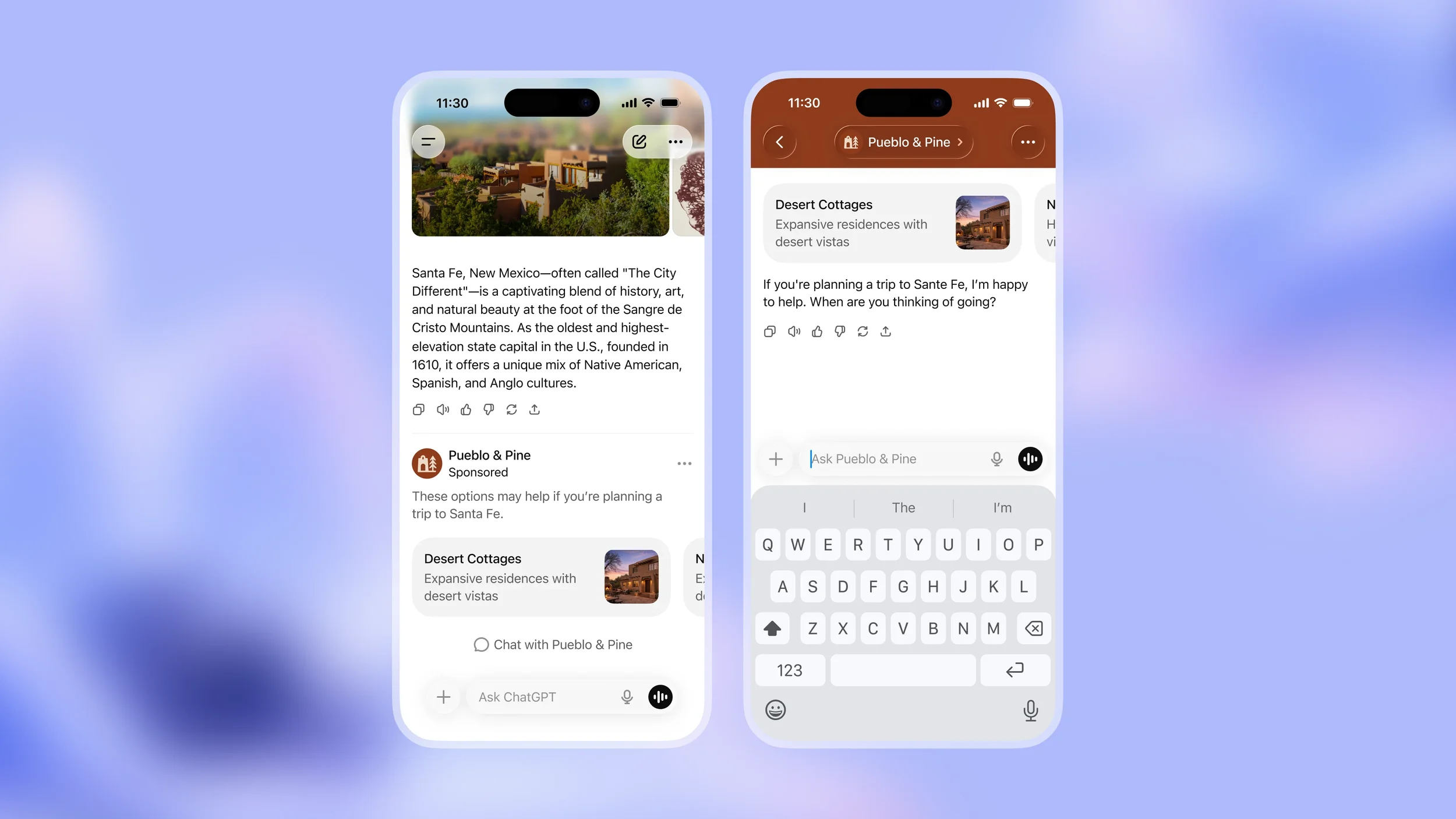
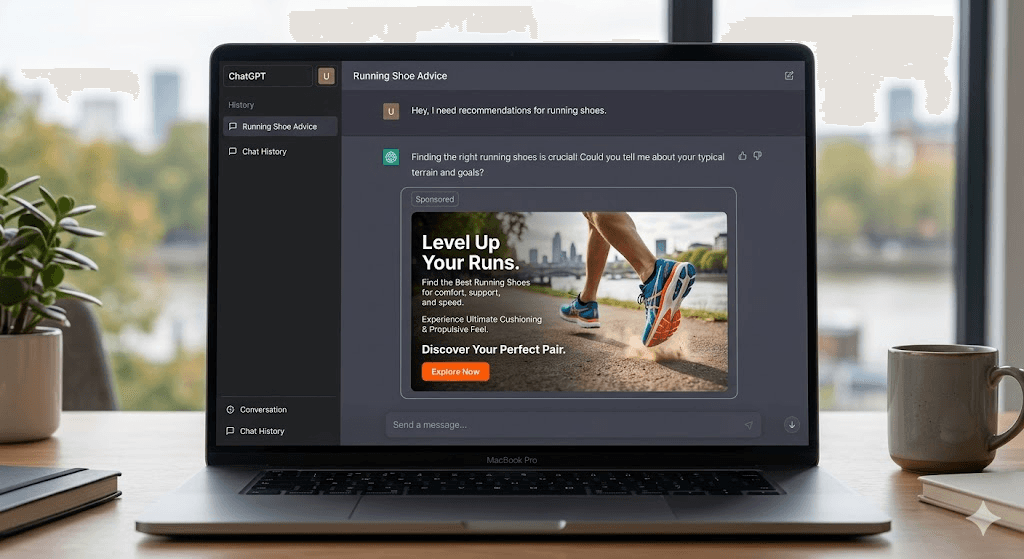
ChatGPT Ads are paid sponsored placements that appear inside ChatGPT conversations. They show up below the end of a ChatGPT response, clearly labelled as sponsored, and visually separated from the organic answer the model generates. When a user asks ChatGPT a question that has commercial relevance, OpenAI matches the conversation context to a relevant advertiser and displays a sponsored card beneath the AI's reply.
The ads appear to logged-in adult users on ChatGPT's Free and Go subscription tiers in the markets where the pilot is live. Plus, Pro, Business, Enterprise and Education users do not see ads. Ads are not eligible to appear near sensitive or regulated topics (health, mental health, politics), and OpenAI excludes sensitive verticals (dating, financial services, politics) from advertising during the current phase.
The important thing to understand is that ChatGPT Ads are not "AI-generated recommendations". OpenAI has been categorical on this point, and it's structurally important: the organic answer the model gives is independent of the ad. The ad is a separate sponsored unit that sits below the answer. Think of it less like a Google Search ad woven into the SERP, and more like a contextual sponsored card that appears after the model has finished being useful. The two systems are editorially separate.
The Data Everyone Needs to Know
Before going deeper, here are the numbers that actually matter for any marketer trying to size this opportunity:
$100 million in annualised revenue within six weeks of launch (OpenAI confirmed this on March 26, 2026)
600+ advertisers active in the pilot, including Best Buy, Target, Expedia, Adobe, Ford, AT&T and Mrs. Meyer's
900 million weekly active ChatGPT users as of February 2026
85% of Free and Go tier users are eligible to see ads; fewer than 20% are shown ads on any given day
Pilot launched February 9, 2026 for logged-in adult users in the US
Self-serve access launched in April 2026
Minimum spend dropped from $250,000 at launch to $50,000 within nine weeks
CPMs fell from $60 at launch to a range of $25–$45 within the same window
CPC pricing introduced in April 2026 with initial bid ranges of $3–$5 per click
Criteo became the first formal ad tech partner on March 2, 2026, connecting approximately 17,000 of its advertiser clients to ChatGPT inventory
Internal OpenAI projections target $102 billion in ad revenue by 2030
For context: Google's entire advertising business was about $43 billion in 2012, fourteen years after launching AdWords. OpenAI is projecting more than double that from ChatGPT ads alone, within four years. Sam Altman called advertising a "last resort" for OpenAI in 2024. That position, as one commentator put it, had a price tag.
Why ChatGPT Ads Matter for Your Business
I want to explain this the way I explain it to clients, which is by starting with what you're actually buying when you buy an impression or a click.
Every ad channel sells attention. The difference between channels is what kind of attention. Meta sells scroll-interrupt attention (people are browsing, half-engaged, open to discovery). LinkedIn sells professional-context attention (people are in work mode, targetable by role and company). Google Search sells intent-compressed attention (people have typed a specific query and want a specific answer). You pay different prices for each because each type of attention has a different value.
ChatGPT sells something new: problem-solving attention.
When someone searches Google, they compress their intent into a keyword: "best CRM for agencies". When someone asks ChatGPT, they typically expand it: "I run a 12-person agency and we're drowning in project handoffs between client services and design, we've outgrown Trello but Monday felt bloated when I tried it, what would actually help me?" That is not a keyword. That is a paragraph of context describing the specific shape of a real problem.
If your ad shows up next to that conversation, you are not interrupting. You are appearing at the exact moment the user is trying to solve the problem your product solves. The intent depth is qualitatively different from anything else in paid media right now.
This is why the commercial signals emerging from the pilot are interesting. Criteo has reported that LLM-referred users convert at roughly 1.5 times the rate of other referral channels. First Page Sage's 2026 conversion rate data shows ChatGPT-influenced traffic converting meaningfully higher than traditional paid channels, with B2B industries seeing the sharpest uplift. The consulting-style nature of ChatGPT conversations aligns well with considered purchase decisions, which is why the pilot has skewed heavily toward retail, travel, software, financial services and professional services.
The flip side matters too: click-through rates in the pilot have been low compared to Google Search. Early reporting suggests CTRs around 1.3% versus Google's ~29%. This is not actually surprising when you think about it. People on ChatGPT got their answer. They're not looking for links the way a Google searcher is. The value of a ChatGPT click is in the intent behind it, not the volume of it. This is why CPC pricing is structurally more interesting than CPM for most advertisers: you only pay when someone chose to engage after the model gave them what they came for.
Who ChatGPT Ads Are Best Suited For
From what I've seen in the early data, the platform is strongest for:
B2B SaaS and software where buyers ask comparison questions and need explanation before committing
Financial services (where not excluded by current policy) — treasury, fintech, investment platforms, cash management
Professional services — legal, accounting, consulting, agencies
High-consideration consumer — home improvement, major appliances, vehicles, healthcare decisions
Education and training — courses, certifications, bootcamps where research is part of the buying process
Developer tools — where the audience is already heavy ChatGPT users
It is weaker for:
Commodity products with minimal differentiation (users don't ask ChatGPT for generic items)
B2B brands targeting senior decision-makers exclusively (who skew heavily toward Plus/Pro plans and won't see ads)
Brands needing tight last-click attribution right now (measurement is still being built; plan for attribution messiness)
Awareness-only campaigns at low CPMs (you'll overpay compared to Meta or YouTube; this is a consideration/intent channel, not a reach channel)
How ChatGPT Ads Actually Work
Let me break the mechanics down clearly, because this is where a lot of the surface-level coverage gets vague.
Where the Ads Appear
A user asks ChatGPT a question. The model generates its answer. If the conversation has commercial relevance and a relevant advertiser is bidding on that contextual category, a sponsored card appears below the response. The card is visually distinct from the answer, labelled as "Sponsored", and typically contains an advertiser's product or service with key details (name, price, a short description, an image). Users can click into the ad, dismiss it, or even "Ask ChatGPT" about the ad to get more information in-chat.
Ads do not appear in:
Temporary Chats
Conversations with users ChatGPT has predicted to be under 18
Accounts on Plus, Pro, Business, Enterprise, or Education tiers
After image generation turns
Inside the ChatGPT Atlas browser
Near sensitive or regulated topics
How Targeting Works
This is the biggest mental shift coming from Google or Meta. ChatGPT's ad system is not keyword bidding. It is contextual conversation matching.
Instead of bidding on "project management software" as a keyword string, you are targeting conversations about team organisation, workflow, collaboration, handoffs, scaling teams. The full context of the conversation informs which ad appears, not just the latest prompt. A user who has spent ten minutes discussing kitchen renovation before asking "what's the best countertop material?" is a different commercial signal from someone who opens a fresh chat and asks the same question cold.
The signals used to match ads, according to OpenAI's own documentation, include:
The current chat thread and what's being discussed
Basic context like general location and language
For users with Personalized Ads enabled (default on since February 2026): past chats, memory, and prior ad interactions
Advertisers never receive user chats, chat history, memories, name, email, precise location, or any sensitive data. They only receive aggregated performance data — impressions, clicks, and (once rolled out) conversions.
How Pricing Works (And Why It's Shifting)
When the pilot launched in February 2026, OpenAI priced ChatGPT ads at a $60 CPM with a $200,000 minimum commitment. That put the platform at roughly three times Meta's typical CPM and on par with Netflix's ad-tier launch and premium TV inventory like NFL games.
Two things have happened since:
CPMs have fallen. Within nine weeks, reported CPMs were trending between $25 and $45, with some buyers going through Criteo reportedly seeing rates as low as $15. Ad Age and Digiday have both reported the downward trend.
The minimum commitment has dropped. From $250,000 at launch to $50,000 by April, with self-serve access opening without enforced minimums for most advertisers.
More importantly, OpenAI turned on cost-per-click pricing in April 2026. Screenshots from the ads manager (reviewed and verified by Digiday) show advertisers setting bids in the $3–$5 per click range. This is structurally significant. CPC pricing lets advertisers pay only when someone engages, rather than for every impression served. It also lets OpenAI grow revenue without needing to hold CPMs up as inventory expands. And it puts ChatGPT in direct comparison with Google Search on the metric that performance marketers actually care about.
For context on CPC expectations: Meta's CPCs typically run three to five times cheaper than Google Search, not because the inventory is worse but because social users are browsing and search users are looking for something specific. LLM conversations start to bridge that gap — intent builds through the back-and-forth of prompt-driven dialogue. Where ChatGPT CPCs ultimately settle will depend on how well the platform proves out conversion value, which is the measurement battle OpenAI is now fighting.
The Ads Manager
OpenAI's ads manager (internally codenamed "bazaar", running on a broader infrastructure called "tapestry") is the self-serve interface that opened in April 2026. It currently supports:
Campaign creation with objectives (impressions today, CPC now, with conversion objectives being built based on code inspection by Adweek)
Keyword and country-level targeting (demographic targeting is not yet available)
Basic reporting — impressions, clicks, and campaign-level data
Bid setting within platform ranges
CPM and CPC buying models
What it doesn't yet have, and what most advertisers will want:
Full conversion tracking (being built according to code analysis of the ads manager)
Audience size estimates
Real-time bidding
Demographic or audience targeting
A/B testing tooling
Mature fraud prevention and attribution infrastructure
This is worth being honest about. If you're running ChatGPT Ads in the first half of 2026, you are building the plane while flying it. The upside is first-mover advantage on a platform growing 36% of OpenAI's total revenue by 2030 if internal projections are right. The downside is you're not going to get Google-grade attribution for a while. Plan accordingly.
How to Set Up ChatGPT Ads (April 2026 Onwards)
Self-serve access opened in April 2026. The practical steps to get started:
Create an account at openai.com/advertisers (the landing point for the ads programme)
Complete the advertiser verification — business details, billing, compliance
Decide on pricing model — CPM if you're optimising for reach in a known category; CPC if you're optimising for engaged clicks and want to compare directly to Google Search economics
Set up conversion events — at minimum, install whatever conversion tracking OpenAI is rolling out; mirror the event to your own analytics so you're never dependent on platform-side reporting alone
Build the ad creative — one or more sponsored product/service cards with clear item name, price or outcome, and a tight one-line description. Do not treat this as a search ad headline. Lead with utility, not promotion.
Set contextual targeting — keyword categories that describe the problem space your product solves, not just your product name. Think in terms of conversations people would have while trying to solve the problem you solve.
Set daily spend and bid caps — start conservatively. CPC bids in the $3–$5 range are the observed norm during the pilot, but your ceiling should be driven by your unit economics, not the platform average.
Build a dedicated landing page — the post-click experience matters disproportionately on this channel, because users have invested effort explaining their situation to the model. If your page doesn't continue that conversation, the click is wasted.
Install robust downstream tracking — UTMs on every ad, CRM pipeline visibility, and a weekly review cadence. Because platform-side attribution is thin, your own data stack is the honest source of truth.
If you are spending less than roughly £1,000/month I'd argue the channel isn't yet mature enough to generate the volume of data you need to optimise. At £2,000–£5,000/month you can run a genuine test. At higher spend you can expand across angles and funnel types in parallel.
Creative Strategy for ChatGPT Ads
The number one thing I'll say about creative here: do not treat ChatGPT Ads like a search ad.
Search ads work because they meet a specific keyword intent with a specific promise, fast. ChatGPT Ads work because they appear after a synthesised answer has already been given. The user has their answer. Your job is not to re-answer the question. Your job is to present yourself as the natural next step for someone who now has a clearer sense of what they need.
Some practical rules from what we're seeing work:
Keep copy outcome-oriented, not feature-oriented. "Cut invoice processing from 20 hours to 2" lands harder than "AI-powered accounts payable automation".
Match the user's language, not your internal product taxonomy. If users are talking about "chasing approvals" don't respond with "workflow orchestration". Mirror them.
Use specifics that reduce decision friction. Price, timing, guarantee, delivery window, number of customers, a concrete before/after. Vague benefits don't work when the user has just been given a detailed, specific answer by ChatGPT.
Never lead with your brand name and a promotional offer. Lead with utility. The conversational context demands that your sponsored placement feel like useful additional information, not a disruption.
Your landing page is the second half of the ad. If the model just summarised a specific plan or configuration, the destination page should restate that plan. If it helped them identify a specific problem, your page should address that problem directly in the hero section. Continuity matters more on this channel than on any other I've run.
Creative testing approach for the first 30–60 days: stick to variations on one or two core message angles rather than launching ten wildly different concepts. The data volume isn't yet high enough to learn anything statistically significant from ten variants at pilot-scale budgets. Get a baseline on a narrow set of angles, then expand.
How ChatGPT Ads Fit Into a Broader Paid Strategy
I want to be clear about what ChatGPT Ads are and are not, because the hype cycle has been intense and the reality is more nuanced.
ChatGPT Ads are not a Google Search replacement. Google processes billions of searches a day. ChatGPT, for all its growth, operates at a fraction of that scale. Anyone framing ChatGPT Ads as a direct Google killer in 2026 is overreaching.
ChatGPT Ads are an intent-dense supplementary channel. They work best sitting alongside Google Search and LinkedIn (for B2B) or Meta (for B2C consideration). They capture a specific kind of high-context, problem-solving moment that Google and Meta don't capture well.
The economic argument for entering now is mostly about learning, not about immediate ROI. The platform's attribution and reporting are not yet mature enough for most performance advertisers to confidently optimise at scale. What you buy by testing now is: a baseline on your category, relationships with the platform, early performance data before competitive pressure drives pricing up, and a position ahead of the next wave of advertisers who'll pile in when self-serve hits mainstream adoption.
At Traction, the way we're thinking about it for B2B clients: run ChatGPT Ads as a test budget (10–20% of paid spend) alongside existing Google and LinkedIn activity. Use the Google Search budget as the anchor for proven intent capture. Use ChatGPT Ads to reach buyers earlier in their decision journey, when they're still scoping the problem. Feed learnings from ChatGPT conversations into Google ad copy and landing page messaging — the language people use in ChatGPT tells you how they actually think about the category, which is gold for the rest of your funnel.
The Trust Problem Nobody Is Solving Yet
I don't want to pretend the picture is uncomplicated. There are real issues with this channel that every advertiser should be honest about.
ChatGPT's appeal was partly built on users feeling that the model's answers were unmediated. When it recommended a product or suggested an approach, no money had changed hands. Advertising breaks that perception, even if OpenAI keeps the organic answer editorially separate from the paid placement. The long-term question is whether users continue to treat ChatGPT's organic responses as neutral once they're used to seeing sponsored cards below them.
Attribution is genuinely hard. Chat is a research environment, and research tends to assist conversions rather than close them. A user might have a four-turn conversation with ChatGPT about project management, click your sponsored card, visit your site, leave, return a week later through a Google search for your brand name, and convert. The ChatGPT click gets no credit in a last-click model. Plan your measurement for this reality: build brand lift tracking, monitor assisted conversions carefully, and don't judge the channel on last-click metrics alone.
Measurement infrastructure is being built in real time. Google and Meta own the industry-standard measurement toolkit, and that's the real moat, not the UI. OpenAI is actively hiring its first advertising marketing science leader and building conversion tracking into the ads manager. Until this matures, expect measurement to be messy.
CTRs are low by Google Search standards. You can rationally explain this (users got their answer, they're not looking for links), but it will feel uncomfortable on a reporting dashboard next to your other channels. Advertisers who optimise purely to CTR on ChatGPT Ads will pull budget prematurely. Optimise to CPA and downstream pipeline quality, not click-through rate.
FAQ
What are ChatGPT Ads? ChatGPT Ads are paid sponsored placements that appear at the bottom of ChatGPT responses, matched to the user's conversation context. They are visually separated from the organic answer and clearly labelled as sponsored.
How much do ChatGPT Ads cost? CPMs have ranged from $60 at pilot launch to $25–$45 in April 2026, with some reports going lower. Minimum spend was $200,000–$250,000 at launch but has dropped to $50,000 and, with self-serve access from April 2026, is expected to fall further for most advertisers. CPC pricing launched in April 2026 with bid ranges of $3–$5 per click observed in the ads manager.
When did ads come to ChatGPT? OpenAI launched ads inside ChatGPT on February 9, 2026, for logged-in adult users in the US on the Free and Go subscription tiers. Self-serve access opened in April 2026. Geographic expansion into Canada, Australia and New Zealand was announced on March 26, 2026.
Do ChatGPT Ads influence the AI's answers? No. OpenAI has stated categorically that ads do not influence the organic answer the model generates. The answer and the ad are editorially separate systems. Whether users continue to trust this at scale is a different question from whether it's mechanically true.
How do I run ads on ChatGPT? From April 2026, advertisers can create accounts and run self-serve campaigns through OpenAI's ads manager. Set up involves creating a campaign, choosing CPM or CPC pricing, setting contextual keyword targeting, uploading sponsored creative, and installing conversion tracking.
Can anyone advertise on ChatGPT? Most business verticals can. Sensitive and regulated categories including dating, health, mental health, financial services (specifically) and political advertising are excluded during the current phase. Availability also varies by region, with the pilot initially US-only before expanding.
Who sees ChatGPT Ads? Ads appear to logged-in adult users on the Free and Go subscription tiers in the markets where the pilot is live. Plus, Pro, Business, Enterprise and Education tier users do not see ads. Ads don't appear in Temporary Chats, in accounts predicted to be under 18, or near sensitive topics.
Are ChatGPT Ads better than Google Ads? They're different. Google Ads captures compressed intent at massive scale. ChatGPT Ads capture deeper contextual intent at smaller scale. The best approach for most businesses in 2026 is to run them in combination, using ChatGPT to reach problem-scoping conversations and Google to capture late-stage comparison searches.
Is ChatGPT Ads worth it for small businesses? With self-serve access and minimums dropping to $50,000 or lower, the platform is becoming viable for mid-market advertisers. For smaller businesses under roughly £1,000/month spend, data volumes are likely too low to optimise meaningfully. The opportunity is real, but it rewards budgets that can generate statistically significant learning over 60–90 days.
What's the difference between ChatGPT Ads and SEO for ChatGPT? They're complementary. Generative Engine Optimisation (GEO) is about getting your brand, content and product to be surfaced inside the organic AI answer. ChatGPT Ads is about buying a sponsored placement below the organic answer. Both matter: organic visibility in AI-mediated discovery is increasingly a brand defence issue, while paid placement lets you capture intent you can't earn organically.
The Bottom Line
ChatGPT Ads are the biggest new paid acquisition channel to launch since TikTok Ads. The combination of scale (900 million weekly users), intent density (problem-solving context), and pricing flexibility (CPM and CPC options, minimums dropping) is unusual. So is the speed of commercial adoption — $100 million in annualised revenue from a fraction of eligible users within six weeks is the fastest ramp I've seen on any new ad surface.
The honest assessment:
The platform is real, the revenue is real, the commercial signal is real
Measurement is thin and will stay thin for several quarters
Performance marketers should expect messy attribution and reward patient testing
Early movers who build experience with contextual conversation targeting will have a pricing and learning advantage over the advertisers who wait until the platform matures
The question is not whether to test ChatGPT Ads, but when and how much
If you're a B2B business with deal sizes above £5,000 and an audience that genuinely uses ChatGPT to research decisions, the argument for starting to test in 2026 is strong. If you're in a commodity category or depend on tight last-click attribution to justify spend, waiting another 6–12 months is defensible.
Either way, this is not a passing trend. Advertising is the mechanism that paid for the open web and paid for social media. It's now paying for conversational AI. The platform that figures out how to prove AI chatbots can drive business outcomes will unlock a budget category that doesn't fully exist yet. OpenAI has taken the first real steps toward that threshold. The advertisers who treat this as a learning opportunity rather than a hype cycle will be the ones ready when the volume catches up with the potential.
Traction is a B2B performance marketing agency building predictable revenue engines for SaaS, fintech and professional services companies. We specialise in paid acquisition, funnel architecture and conversion optimisation across Meta, LinkedIn, Google, and emerging channels including ChatGPT Ads. If you want to test ChatGPT Ads as part of a broader B2B acquisition strategy, get in touch.