Playter case study: building an inbound acquisition engine for B2B BNPL
4

Playter is the B2B Buy Now Pay Later platform that's lent hundreds of millions to UK SMEs and was acquired by Shawbrook Bank.
They came to Traction with a single question: could we build an inbound function that delivered the same volume their outbound team was generating, at a lower cost per opportunity?
Here's exactly how we did it across Meta, Google, and LinkedIn.
Headline results
~£20 Blended cost per lead across Meta
£480/day Daily Meta ad spend at scale
4 Active funnel types running concurrently
About Playter
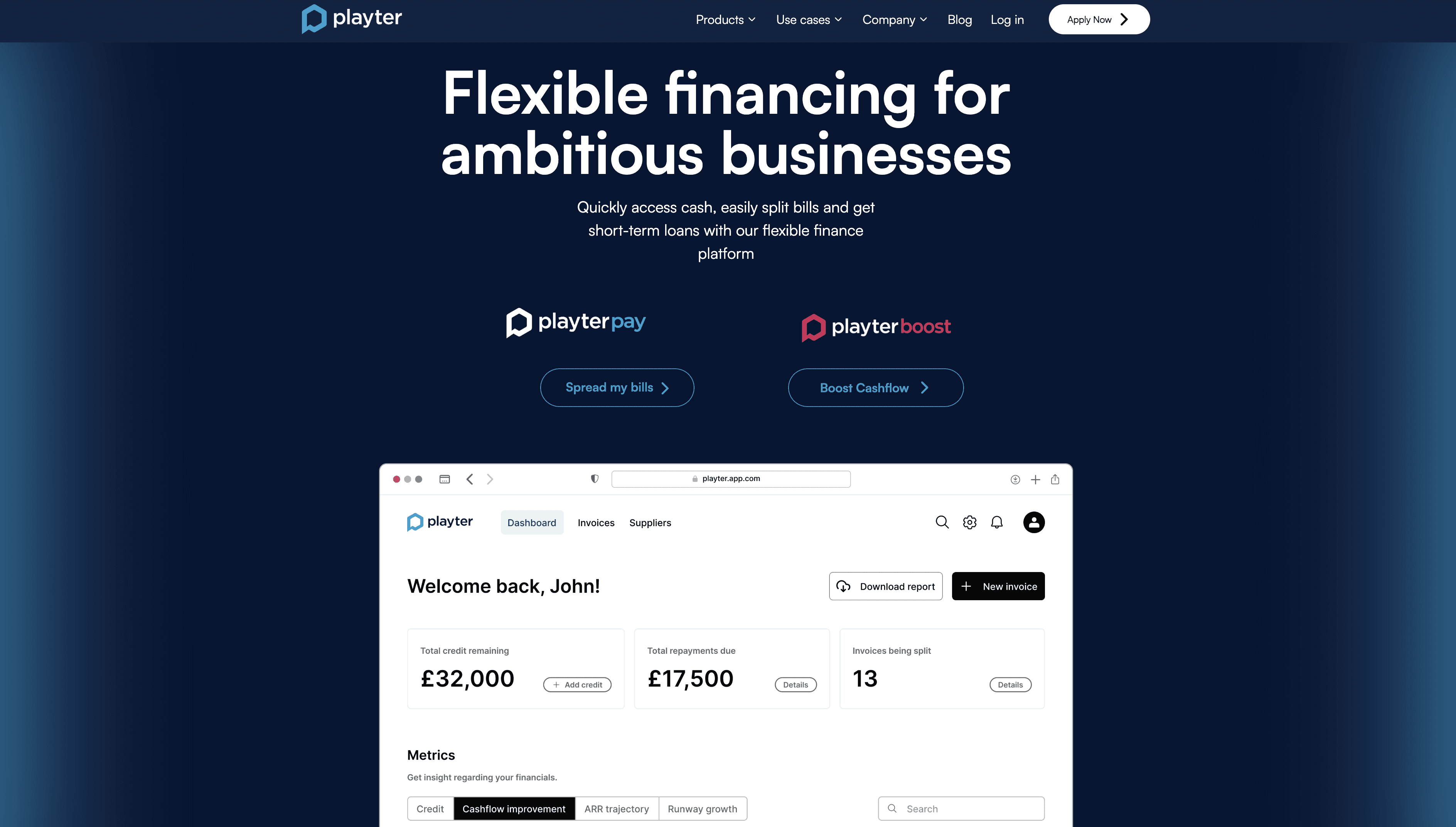
Playter is a B2B Buy Now Pay Later platform that lets UK businesses spread the cost of their invoices over 6 or 12 months.
The product turns large, lumpy supplier invoices into manageable monthly instalments.
It's particularly useful for fast-growing companies funding things like marketing agencies, SaaS subscriptions, recruitment fees, and legal costs.
Anywhere cash flow timing creates friction, Playter solves it.
The category sits at the intersection of B2B fintech and embedded finance.
It's a relatively new product for UK SMEs. Most businesses still default to traditional business loans, invoice finance, or credit cards when they hit cash flow constraints.
That meant Playter wasn't just acquiring customers. They were educating an entire market on a new way to fund their operations.
By the time they came to Traction, Playter had raised over $55M in funding and lent hundreds of millions to UK SMEs.
They've since been acquired by Shawbrook Bank, a major UK specialist lender, which validates both the category and the team.
But none of that scale would have been possible without a working customer acquisition engine.
That's where we came in.
Where Playter was before working with Traction
Here's the berfore and after snapshot:
Before | After |
|---|---|
8 outbound SDRs cold prospecting UK SMEs. | Paid acquisition delivering inbound qualified leads daily. |
Acquisition entirely dependent on sales team capacity. | Acquisition decoupled from headcount, scales with budget instead. |
No tested message-market fit at scale. | Two distinct creative angles validated across thousands of impressions. |
Single channel (outbound), no diversification. | Four channels running: Meta prospecting, Meta retargeting, Google Search, LinkedIn. |
No funnel infrastructure beyond direct sales calls. | Quiz funnels, instant forms, and dedicated landing pages tested in parallel. |
What we built
Establishing message-market fit on Meta first
Playter's biggest unknown wasn't whether the product worked.
It was which positioning would resonate with a cold UK SME owner scrolling Facebook or Instagram.
There's a meaningful difference between leading with a category-defining message ("Buy Now Pay Later for B2B") and leading with a feature-led promise ("Split Your Bills Over 6 or 12 Months").
The first sells the concept. The second sells the mechanism.
We needed to know which one drove cheaper, higher-quality leads before scaling spend in any direction.
What we did.
We built two parallel creative tracks on Meta and ran them against the same audiences with separate landing experiences.
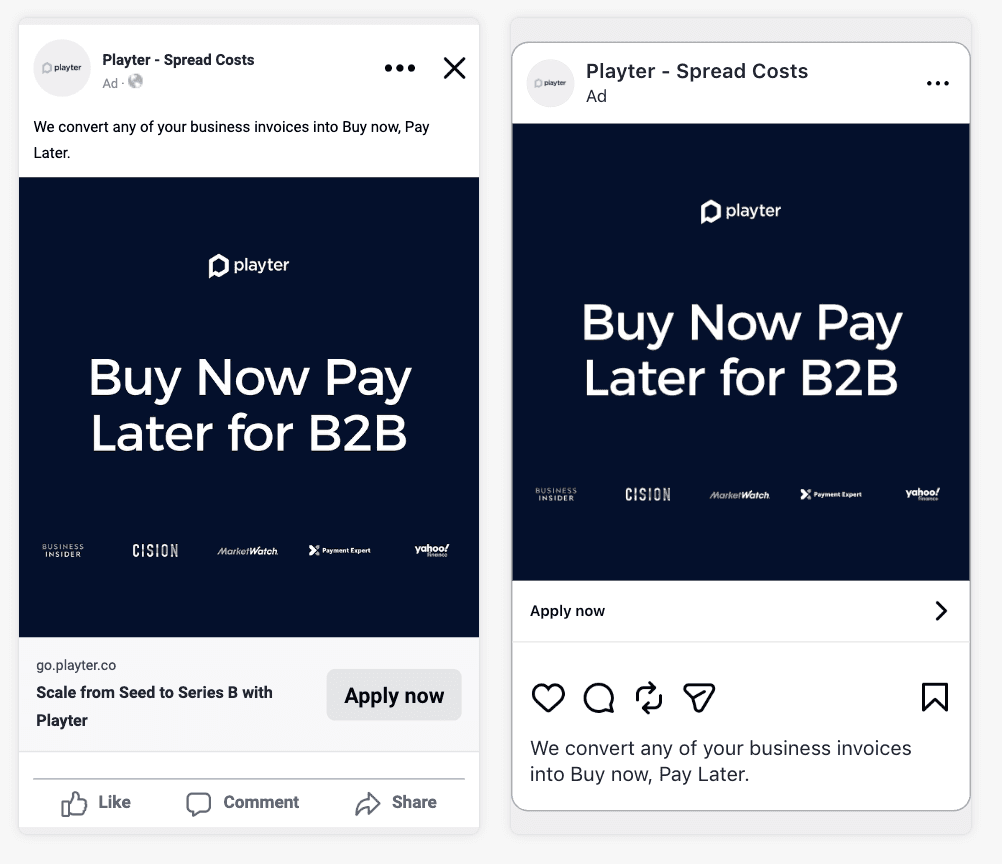
The first was a clean, high-contrast brand-led ad. Dark navy, bold typography, "Buy Now Pay Later for B2B" as the dominant message, with press logos (Business Insider, Cision, MarketWatch, Yahoo Finance) underneath as authority signals.
The second was a product-forward creative. Bright cyan, actual UI screenshots of the dashboard showing a bill being split across 12 months, with the headline "Split Your Bills Over 6 or 12 Months".
Same audience targeting. Same offer. Different cognitive entry point.
The judgement call.
We deliberately ran these as separate campaigns rather than as ads within a single ad set, even though that fragmented learning.
The reason: Meta's algorithm optimises within an ad set. If one creative had taken off early, it would have starved the other of impressions before we had clean comparative data.
By isolating them at the campaign level, we got a cleaner read on what each angle was actually doing, at the cost of slightly higher initial CPMs.
Outcome.
We landed at a blended cost per lead of around £20 across the Meta account at £480/day spend.
That number worked because Playter's deal economics could comfortably support that CPL given typical loan sizes and repayment volumes.
Running four funnel types in parallel
Most B2B brands pick one funnel and try to optimise it.
That's the right move at maturity. But early in an engagement, you don't know which funnel architecture will work best for your specific audience and offer.
Assuming you do is how agencies waste 90 days on the wrong setup.
For Playter, we ran four different funnel structures simultaneously across the Meta account to find out.
What we did.
We built and ran:
1. Meta Lead Gen with native instant forms. A low-friction, on-platform funnel that captured leads without sending them to a landing page. Highest volume, lowest intent.
2. DCT (Dynamic Creative Testing) with instant forms. Same on-platform capture, but using Meta's creative permutation engine to find winning combinations of headline, body copy, and visual.
3. DCT with landing page leads. Same creative testing approach, but routed through a Playter-hosted landing page where prospects converted via a longer form. Higher intent, more qualifying data captured.
4. Retargeting. Warm audiences from website visitors and ad engagers, served direct application CTAs at materially lower cost (£1.78 to £3.26 per lead in retargeting compared to £5.57+ in cold prospecting).
The judgement call.
The native instant form campaign had the highest cost per lead in the account, but we kept running it.
Two reasons.
First, the absolute lead volume justified the higher CPL.
Second, it was building the retargeting pool that fed the cheaper warm campaigns downstream.
A common mistake in B2B paid acquisition is killing the top-of-funnel campaign that "looks expensive" without recognising it's the audience-builder for everything else.
We always look at the account holistically before pausing top-of-funnel spend.
The Outcome.
Four funnels running gave us a layered acquisition system rather than a single point of failure, plus richer data on which message-funnel combinations converted best.
Layering Google Ads to capture in-market demand
Meta and LinkedIn create demand. Google captures it.
Once we'd validated the messaging on Meta, we knew there was real category interest.
But the people most likely to convert weren't the ones being interrupted on social.
They were the SME owners actively typing "business loan", "SME funding", or "business funding" into Google at the exact moment they had a cash flow gap to solve.
Our job on Google was to be there when that intent showed up.
What we did.
We built five tightly-themed Google Search campaigns, each one mapped to a different keyword intent layer:
Campaign | Intent Layer |
|---|---|
Traction.so - Business Funding | Generic high-intent ("business funding", "SME funding") |
Traction.so - Duplicate - Business Funding | Volume-test duplicate to manage budget allocation |
Traction.so - Playter - business loan | Branded modifier blend ("Playter business loan") |
Traction.so - Playter - SME Loan | Mid-funnel targeted SME loan keywords |
Traction.so - Playter - DSA | Highly specific DSA (Direct Sales Agent) keyword theme, niche but high CTR |
The campaigns showed dramatically different performance signatures.
The DSA campaign hit a 40% click-through rate on small impression volume. That told us we'd found a hyper-relevant audience pocket.
The SME Loan campaign delivered 6.10% CTR at £1.18 CPC. Strong economics.
The duplicate Business Funding campaign ran at 0.81% CTR and £2.71 CPC. Useful as a budget overflow for the broader campaign, but clearly doing different work.
The judgement call.
We didn't optimise to a single Google CPA target across the whole account.
Different keyword intents have different downstream conversion behaviour.
Trying to make a generic "business funding" keyword hit the same CPA as a branded query is how you end up scaling spend on the wrong terms.
We let each campaign find its own equilibrium and judged them individually against the role they played in the broader acquisition system.
Generic terms feeding awareness. Mid-funnel keywords driving applications. Branded keywords closing the loop on demand created by Meta.
Outcome.
Google became the layer that monetised the demand Meta and LinkedIn were creating.
Without it, paid social spend would have been leaking to competitors when prospects went off-platform to research.
Adding LinkedIn for precision targeting on the higher-intent buyer
Some of Playter's best-fit customers are easier to identify by job title and industry than by interest-based targeting on Meta.
Particularly those running marketing agencies, recruitment firms, or professional services.
LinkedIn lets you target people by exact role, company size, and industry in ways no other platform does.
The trade-off is cost. LinkedIn CPMs and CPCs run materially higher than Meta.
So LinkedIn is only worth running when the ICP is precisely targetable by professional attributes and the deal economics support the higher acquisition cost.
What we did.
We layered in LinkedIn campaigns targeting decision-makers at UK SMEs in industries with predictable invoice patterns.
Agency founders. Finance leads at fast-growing companies. Operations directors at firms with regular high-value supplier costs.
Creative leaned into the "Buy Now Pay Later for B2B" positioning rather than the feature-led variant, because the LinkedIn feed rewards clarity-of-concept over feature explanation.
The judgement call.
We didn't try to make LinkedIn beat Meta on cost per lead.
That's a losing battle and the wrong frame anyway.
The right metric on LinkedIn is cost per qualified opportunity, because the leads that come through tend to be tighter ICP matches with bigger downstream loan sizes.
We tracked LinkedIn's contribution at the pipeline level, not the lead level.
Outcome.
LinkedIn became the precision channel. Lower volume, higher quality. It complemented Meta's broad reach.
Key takeaways for B2B fintech and embedded finance brands
If you're hiring SDRs to scale acquisition, you're scaling the wrong asset.
Outbound headcount has linear economics. Every new lead requires a new salary.
A working paid acquisition system has compounding economics. Once you've found the winning message-funnel combination, scaling spend produces more leads without proportionally more cost.
Playter's move from 8 outbound SDRs to a paid-acquisition-led model wasn't about replacing the team. It was about building a second, more scalable acquisition layer alongside it.
Run multiple funnel types in parallel before committing to one.
The instinct in B2B is to pick a funnel architecture (quiz funnel, demo funnel, lead gen form) and optimise it relentlessly.
That's right at maturity. But early on, the constraint isn't optimisation. It's discovery.
Running 3 to 4 funnel types in parallel for the first 60 days lets the data tell you which architecture fits your audience, rather than guessing.
In paid acquisition for fintech, the message-market fit problem is bigger than the optimisation problem.
Most fintech brands lose money in paid not because their bidding is wrong, but because they're testing the wrong angles.
We always run a brand-led concept against a feature-led concept early in any engagement, on isolated campaigns, to find out which mental model the buyer actually responds to before scaling spend.
Don't kill expensive top-of-funnel campaigns without checking what they're feeding downstream.
A Meta prospecting campaign at £25 CPL might look bad in isolation.
But if it's the campaign building the retargeting audience that converts at £1.78 CPL, killing it collapses the cheaper retargeting layer.
Always audit holistically.
Google Search and Meta do different jobs for fintech. Run both, measure them differently.
Meta and LinkedIn create demand. Google captures it.
If you're only running one, you're either paying to educate prospects who then go and convert through someone else's branded search ad, or you're competing for tiny pools of in-market intent without ever expanding the category.
The full-stack approach (paid social to create demand, paid search to capture it) is the standard architecture for B2B fintech in 2026.
Branded search defends the demand you've created.
As Meta and LinkedIn drive awareness, prospects increasingly Google your brand name to research before applying.
If competitors are bidding on your brand keyword (and in B2B fintech they often are), you're paying twice. Once to create the demand, again to recapture it from a competitor's branded ad.
Always run a branded search campaign defensively.
Stack used
Layer | Tools |
|---|---|
Paid channels | Meta Ads, Google Ads, LinkedIn Ads |
Funnel building | Perspective (quiz funnels), Meta native instant forms |
Tracking | Meta Pixel, Google Tag Manager, LinkedIn Insight Tag |
Creative | Static ads (cold prospecting + retargeting), DCT for permutation testing |
Reporting | Looker Studio + connector layer for blended channel view |
Working in B2B fintech, embedded finance, or SME lending?
We help fintech and SaaS brands build paid acquisition systems that replace or augment outbound, without burning runway on the wrong creative, the wrong channel, or the wrong funnel architecture.
If you're considering scaling beyond outbound, or your current paid setup isn't producing inbound demos at unit economics that work, we should probably talk.